Presbyopia and Multifocal Contact Lenses: A Practical Guide
Presbyopic patients can wear contact lenses successfully, but multifocal fitting takes more than copying the near addition. Here's the clinical approach.
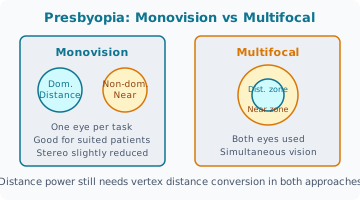
Quick Answer: Presbyopic patients need their distance contact lens power converted from the spectacle Rx using vertex distance, just like any other wearer. The near addition is then layered on top, but it's the corrected distance power that forms the foundation of a successful multifocal fit.
Presbyopia doesn't mean the end of contact lens wear. What it does mean is that fitting gets a layer more involved. The common mistake isn't the near addition. It's fitting the distance power incorrectly and then wondering why vision at all distances feels compromised.
What Presbyopia Actually Is
The crystalline lens inside the eye gradually loses its flexibility from about age 40 onwards. Younger eyes can shift focus from distance to near in a fraction of a second by flexing the lens (accommodation). By the mid-40s, the near focus point has retreated to beyond arm's length, and reading without glasses becomes uncomfortable.
A typical presbyopic progression looks like this:
These are population averages. Individual variation exists, and some patients reach full presbyopia (+2.50D add) earlier than expected.
Multifocal Lens Designs: What's Actually in the Lens
Not all multifocal contact lenses work the same way. Understanding the optical design helps with fitting and with explaining to patients why their multifocals might not work the same as their varifocal spectacles.
Simultaneous Vision Lenses
Most soft multifocal contacts use simultaneous vision. Multiple focal zones are presented to the pupil at the same time, and the brain selects the in-focus image. There are two main sub-types:
Concentric zone lenses alternate rings of distance and near power. In some designs, the central zone is distance (suited to larger-pupil patients in dim light); in others, near is central (better for bright-light reading).
Aspheric lenses gradually blend power from centre to periphery. These are the most commonly prescribed. Brands like Dailies Total1 Multifocal and ACUVUE OASYS with Transitions use aspheric gradient designs. The transition is smooth, which many patients find more natural than distinct zone lenses.
Alternating Vision (Translating) Lenses
Rigid gas-permeable multifocal lenses can be designed to physically translate on the eye. The near zone moves in front of the pupil when the patient looks down to read. This mimics how a bifocal spectacle works. These are less common but can achieve excellent acuity at both distances for the right patient.
Vertex Distance and the Distance Power
Here's the step that's easy to skip: before thinking about the add, the distance power needs a proper vertex distance conversion.
A presbyopic patient with a spectacle Rx of +3.00D distance power and a +2.00D add doesn't just need a +3.00D contact lens for distance. At 12mm vertex:
F_cl = +3.00 / (1 − 0.012 × +3.00)
F_cl = +3.00 / (1 − 0.036)
F_cl = +3.00 / 0.964
F_cl = +3.11D → rounds to +3.25D
That 0.25D difference might seem small, but it's the foundation of the entire fit. An under-plussed distance power means the patient is always working their residual accommodation harder than they should be. For a presbyope who has little accommodation left, that matters.
Use the contact lens vertex power calculator to convert the distance power before you start choosing the add. Get that number right first.
Monovision vs. Multifocal: Choosing the Right Approach
Not every presbyopic patient suits a multifocal design. Monovision, fitting one eye for distance and one for near, is a viable alternative with different tradeoffs.
Monovision
The dominant eye wears the distance correction; the non-dominant eye wears the near correction (typically the full add subtracted from the distance power). Binocular summation is lost and stereoacuity is reduced, which matters for driving, sport, and precision near tasks.
Patients adapt better to monovision when:
- The add power is ≤ +1.50D (less disparity between the two eyes)
- They don't need fine stereoacuity at either distance
- They've already adapted to monovision in the past
Identifying the dominant eye: Use the hole-in-card test. Patient extends both hands with fingers forming a small hole, looks at a distant object through the hole, then closes each eye alternately. The eye that keeps the object in view is the dominant eye; fit that eye for distance.
Multifocal
Multifocal lenses preserve more binocularity but ask the brain to do more work in selecting the correct image. They work best when:
- The patient has realistic expectations (functional vision, not emmetropic quality)
- Pupils are an appropriate size (very small pupils in bright light may restrict the near zone)
- Pupil size at near is ≥ 3.5mm
Roughly 80% of patients can achieve functional distance and near vision with current multifocal designs. "Functional" means they can drive and read comfortably. It doesn't always mean 6/5 acuity at every distance. Setting this expectation before fitting protects the fitting relationship.
Selecting the Add Power for Contact Lenses
The spectacle add is your starting point, not your endpoint. Near additions in contact lenses are specified differently from spectacle adds, and the two don't map directly.
Most multifocal lens ranges offer Low, Medium, and High additions (or Low/High only):
- Low add: typically +0.75D to +1.25D (early presbyopes)
- Medium add: approximately +1.50D to +2.00D
- High add: +2.25D and above
For a patient with a +1.75D spectacle add, start with the Medium add in the trial lens. The lens design interacts with the patient's residual accommodation and pupil size. The final add needed in the contact lens is often one step lower than the spectacle add for early presbyopes, because the lens optics are doing some of the work the accommodation was doing.
Don't be surprised if a patient with a +2.25D spectacle add functions well with a High add multifocal contact. Some need the full power; others find it causes distance blur and do better with Medium.
Practical Fitting Tips
Trial period matters more than for single-vision lenses. Neuroadaptation to simultaneous vision takes time. Some patients show poor vision in the first 2–3 days and acceptable vision by day 7–10. Build a 2-week trial period into the fitting process.
Assess lighting conditions. Simultaneous vision lenses perform worse in dim light because larger pupils admit more of the competing focal zones. If a patient reports good vision in bright conditions but struggles at dusk, this is the likely cause.
Balance the fit, not just the add. Over-plussing the near correction to help reading can create distance blur. If the patient can read well but distance is soft, reduce the add by one step or try a distance-dominant lens design.
For hyperopic presbyopes, see our post on [hyperopia and contact lens prescriptions](/blog/hyperopia-contact-lens-prescription). These patients are fitting on a higher base power and the add sits on top of an already-significant plus lens.
When Multifocals Don't Work
Some patients simply can't adapt to simultaneous vision. Common scenarios:
- High-demand visual tasks (surgeons, fine artists) where monovision or single-vision lenses with reading glasses are more practical
- Very small pupils (< 3.0mm at near) that don't admit enough of the near zone
- Large anisometropia where one eye is significantly better than the other and dominates
In these cases, single-vision distance contacts combined with over-the-counter reading glasses is a legitimate and comfortable option that doesn't require a failed multifocal trial to arrive at. For these patients, a correct vertex distance conversion for the distance single-vision lens is still essential; run the numbers with the vertex distance calculator before fitting.
Our about page covers how this tool supports practitioners across the full range of fitting scenarios, presbyopes included.