Fitting Toric Contact Lenses: Vertex Distance for Astigmatism
Astigmatic prescriptions need vertex distance conversion for both sphere and cylinder. Here's how to approach toric lens fitting with accurate converted powers.
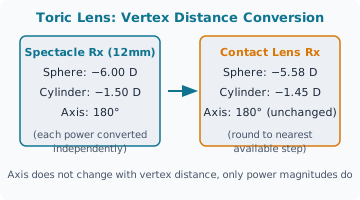
Quick Answer: When converting a toric spectacle prescription to contact lens powers, both the sphere and cylinder need vertex distance conversion, but the axis stays exactly the same. For −4.00 / −2.00 × 180 at 12mm vertex, the contact lens powers become approximately −3.83D sphere and −1.93D cylinder.
A patient with astigmatism hands you a spectacle Rx of −6.00 / −2.50 × 175 and wants to switch to toric lenses. Writing those numbers directly on the fitting form is a mistake, and a surprisingly common one. The sphere needs converting, the cylinder needs converting, and only the axis gets to stay put.
Why Both Sphere and Cylinder Are Affected
Astigmatism means the eye has two principal meridians, each with a different refractive power. A spectacle cylinder sits at 12mm from the cornea, the same as the sphere, so both meridians of power are equally subject to the vertex distance effect.
The axis tells you the orientation of the cylinder, not its power. Since we're moving the lens from 12mm in front of the eye to 0mm (the corneal plane), the angle doesn't change; only the magnitude of power in each meridian does.
The correct technique is to convert each principal meridian separately, then reconstruct the sphere/cylinder/axis combination from the converted values.
Step-by-Step Conversion for a Toric Prescription
The vertex distance formula is the same as for spherical prescriptions:
F_cl = F_spec / (1 − d × F_spec)
where d is the vertex distance in metres (0.012 for 12mm).
Example: −4.00 / −2.00 × 180
Step 1: Identify the two principal meridians.
- Meridian at 180°: −4.00D (the sphere power alone)
- Meridian at 90°: −4.00 + (−2.00) = −6.00D (sphere plus cylinder)
Step 2: Convert each meridian.
Meridian at 180°:
F_cl = −4.00 / (1 − 0.012 × −4.00)
F_cl = −4.00 / (1 + 0.048) = −4.00 / 1.048 = −3.82D

Meridian at 90°:
F_cl = −6.00 / (1 − 0.012 × −6.00)
F_cl = −6.00 / (1 + 0.072) = −6.00 / 1.072 = −5.60D
Step 3: Reconstruct sphere, cylinder, and axis.
- Sphere = the less minus (more positive) converted meridian = −3.82D
- Cylinder = the difference = −5.60 − (−3.82) = −1.78D
- Axis = 180 (unchanged)
Step 4: Round to available toric lens powers. Standard toric soft lenses step in 0.25D for sphere and 0.50D for cylinder, so the nearest available prescription is approximately −3.75 / −1.75 × 180.
You can run this calculation faster using the contact lens vertex power calculator. Enter the sphere and cylinder powers, set the vertex distance, and the converted values appear instantly.
When to Use the Full Toric Conversion vs. Spherical Equivalent
Not every patient with mild astigmatism needs a toric lens. If the cylinder is 0.75D or less, many patients do fine with a spherical soft lens fitted using the spherical equivalent (SE):
SE = Sphere + (Cylinder / 2)
For −4.00 / −0.75 × 90, the SE is −4.375D, which rounds to −4.25D or −4.50D in a spherical lens. This works when the uncorrected cylinder doesn't significantly affect best corrected visual acuity.
The decision to go full toric should account for:
- Cylinder magnitude ≥ 1.00D usually warrants toric correction
- Patient occupation (driving, detailed close work)
- How well the patient tolerates residual astigmatism in spectacles vs. contacts
For SE fitting, you still need vertex distance conversion. Apply the formula to the spherical equivalent power as you would for any other spherical Rx.
Contact Lens Availability Constraints
This is where clinical reality bites. The calculated toric power is a theoretical ideal; the ordered lens is what's actually available.
Most major toric soft lens ranges offer:
- Sphere: typically −0.25D to −9.00D in 0.25D steps (some extend to ±20.00D in 0.50D steps)
- Cylinder: −0.75D, −1.25D, −1.75D, −2.25D, −2.75D (0.50D intervals)
- Axis: every 10° from 0° to 180° in standard ranges; some offer 5° steps
The cylinder limitation matters most. If your conversion gives −2.10D of cylinder, the nearest available step is −2.25D. The 0.15D residual astigmatism that introduces is usually acceptable, but it's worth flagging to the patient rather than letting them wonder why things aren't quite as sharp as their spectacles.
Stabilisation Axis vs. Prescription Axis
Toric lenses use various stabilisation mechanisms to prevent rotation on the eye: prism ballast, peri-ballast, and dual thin zones. None of these is perfect.
A lens designed with the cylinder axis at 180° will rotate slightly on most eyes. If your trial lens consistently sits 10° off axis (measured by the rotation marking), the ordered axis should compensate:
- Lens rotates nasally (to the right in the right eye) → axis is less than expected → order an axis 10° lower
- Lens rotates temporally → order an axis 10° higher
The mnemonic LARS (Left Add, Right Subtract) refers to how you adjust the axis based on lens rotation direction, but it's the spectacle Rx axis being adjusted, not the anatomical rotation. If the spectacle cylinder is at 175° and the lens rotates 10° to the left, you add 10° and order 185°, which wraps to 5°.
The converted power doesn't interact with the rotation adjustment. These are separate steps. First convert the powers; then adjust the axis for lens rotation at the fitting assessment.
Overrefraction After Toric Fitting
A fitted toric lens is a starting point. Overrefraction tells you whether the power and axis are working at the corneal plane under real conditions: with the lens on, the blink reflex active, and the tear film doing its thing.
Perform a standard subjective refraction over the trial lens. The result in sphere gives you the power error; a residual cylinder indicates either incorrect cylinder power, axis rotation, or residual astigmatism not correctable by the lens.
For a patient wearing −3.75 / −1.75 × 180 who overrefracts to +0.25 / −0.25 × 180, the final power needed is:
- Sphere: −3.75 + 0.25 = −3.50D
- Cylinder: −1.75 + (−0.25) = −2.00D
- Axis: 180 (combined by algebraic addition when axis matches)
When the overrefraction cylinder axis doesn't match the trial lens axis, use vector addition or simply trial a new lens with the combined power. Our about page describes the clinical principles that guide how this tool handles those calculations.
High Astigmatism: When the Conversion Matters Most
For prescriptions with cylinder ≥ 2.00D combined with sphere ≥ 4.00D, the vertex distance effect on cylinder becomes substantial. A −6.00 / −3.00 × 90 spectacle Rx at 12mm:
Meridian at 90°:  −6.00 / 1.072 = −5.60D
Meridian at 180°: −9.00 / 1.108 = −8.12D

Contact lens Rx: −5.60 sphere, cylinder = −8.12 − (−5.60) = −2.52D
Nearest available: −5.50 / −2.50 × 90
Without conversion, you'd order −6.00 / −3.00 × 90. The sphere is 0.50D too minus and the cylinder is 0.50D too strong. That's two meaningful errors compounding each other.
See our post on high prescriptions and vertex distance for more on how errors compound at the extremes of the refractive range. For the conversion arithmetic itself, the toric vertex distance calculator handles sphere and cylinder simultaneously.