Vertex Distance and High Prescriptions: What Changes
For prescriptions above ±6.00 D, ignoring vertex distance can mean a half-dioptre error in your contact lens fitting. Here's what you need to know.
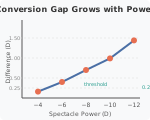
Quick Answer: The vertex distance effect grows non-linearly with prescription strength. At −12.00 D the difference between spectacle and contact lens power exceeds 1.40 D, making accurate conversion non-negotiable for high prescriptions.
A −4.00 D prescription and a −12.00 D prescription don't just differ in how blurry things look. They also differ in how dramatically the vertex distance conversion changes the final contact lens power. The relationship isn't linear. It accelerates.
Why High Prescriptions Amplify the Effect
The formula for contact lens power is:
F_cl = F_spec / (1 − d × F_spec)
The denominator (1 − d × F_spec) is what drives the amplification. At low powers, the term d × F_spec is small and the denominator stays close to 1. At high powers that term grows, and the denominator moves further from 1, magnifying the difference between F_spec and F_cl.
Think of it this way: at −4.00 D with a 12 mm vertex, the denominator is 1.048. At −12.00 D it's 1.144. That larger denominator divides into a much larger numerator, producing a much bigger absolute correction.
The Growing Gap: Worked Examples at 12 mm BVD
Here's how the vertex conversion plays out across a range of myopic prescriptions, all at the standard 12 mm vertex distance:
At −12.00 D, prescribing directly from the spectacle Rx would leave the patient more than one dioptre over-minused in their contacts. That's not a rounding error. It's a clinically meaningful miss. Use the contact lens vertex power converter to run any of these calculations for your specific patient.
The same amplification applies to hyperopes, in the opposite direction: the higher the plus power in the spectacles, the more additional plus is needed in the contact lens.
Minification and Magnification: The Visual Bonus for High Myopes
High myopic spectacles are thick, heavy, and minify the world. Objects look smaller than they really are. Contact lenses eliminate most of that minification because the correcting surface is now on the cornea rather than 12 mm in front of it.
For a −10.00 D patient, switching from spectacles to contact lenses typically produces around 20% magnification in retinal image size. That means objects appear noticeably larger, a genuine visual benefit beyond just correcting the refractive error.
This also means that patients who are new to contact lenses at high prescriptions may need a brief adaptation period. The world genuinely looks different, not because the correction is wrong, but because the optics have changed.
Binocular Balance in Anisometropia
For patients with significantly different prescriptions in each eye (anisometropia), spectacles can create unequal image sizes (aniseikonia) that stress binocular vision. Contact lenses substantially reduce this because both corrections are at the corneal plane. High anisometropes often report better binocular comfort in contacts than in spectacles even when both are well-corrected.
High Hyperopes: The Steeper Problem
High hyperopes present an additional complication: the spectacle prescription may significantly under-represent the true refractive error if the patient has been using accommodation to compensate. A cycloplegic refraction is important for establishing the full hyperopic Rx.
Once the spectacle Rx is confirmed, the vertex conversion for high plus prescriptions is substantial. A +8.00 D patient needs nearly +9.00 D in their contact lens, an entire dioptre more. Underprescribing here means the patient can't clear distance without straining their accommodation. You can verify the exact figure using the vertex distance tool before committing to a trial lens.
High hyperopic contact lens powers are also less commonly stocked by suppliers, so the practical rounding step may be 0.50 D rather than 0.25 D at powers above +6.00 D. Factor this into your trial lens selection.
Fitting Options for Very High Prescriptions
Standard soft lenses max out around ±12.00 D to ±20.00 D depending on the manufacturer. Beyond that, or when optical quality at high powers is insufficient in a soft lens, other options come into play.
Rigid Gas Permeable (RGP) Lenses
RGPs can be manufactured across a much wider power range than soft lenses, and their rigid optics mean less aberration in high corrections. The main trade-off is adaptation time: most patients need 2–4 weeks to become comfortable with RGPs.
Scleral Lenses
Sclerals vault over the cornea and rest on the sclera, which matters less for pure refractive corrections but makes them indispensable for patients with corneal irregularity (keratoconus, post-surgical corneas). They can be made to very high powers and offer excellent optics. Vertex distance conversion still applies when deriving the back vertex power of the lens.
Piggyback Systems
A soft lens worn under an RGP modifies the effective tear lens and can allow an RGP to be fitted where corneal tolerance is low. The combined power must be calculated carefully: the soft lens power is typically subtracted from the required correction before the RGP is designed.
Overrefraction: Essential for High Prescriptions
At low powers, a 0.25 D error in a trial lens is trivially confirmed by asking the patient whether "1 or 2" is clearer. At high powers, residual astigmatism, small vertex variations, and the non-linear nature of the correction mean that overrefraction is the only way to confirm the final power accurately.
Always perform overrefraction with a high prescription patient wearing their trial lens, and don't skip it because the converted calculation looks clean. Learn about the full fitting workflow in our guide to spectacle to contact lens conversion, and more about common errors in contact lens fitting mistakes.
Our about page covers the methodology we use when building the conversion logic behind this site.