7 Contact Lens Fitting Mistakes to Avoid
From skipping vertex distance conversion to ignoring tear film quality, these are the most common contact lens fitting errors and how to avoid them.
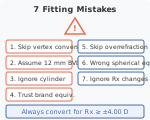
Quick Answer: The most avoidable contact lens fitting errors come down to three habits: skipping vertex distance conversion on prescriptions above ±4.00 D, not measuring actual vertex distance for high Rxs, and failing to overrefract with the trial lens in place.
Contact lens fitting looks routine until something goes wrong. A patient returns two weeks in, saying the vision "just isn't right." Sometimes the lens is decentring. More often, the power was wrong from the start, and the error was preventable.
Here are seven mistakes that come up repeatedly in practice, along with what actually happens to the patient and how to stop them before they start.
Mistake 1: Copying the Spectacle Power Without Vertex Conversion
This is the most common error for patients with prescriptions above ±4.00 D, and it's entirely avoidable.
Spectacle lenses sit roughly 12 mm in front of the cornea. Contact lenses sit on it. That distance changes the effective power of the correction. For a −8.00 D myope, the correct contact lens power is about −7.30 D, nearly 0.75 D less minus. Prescribing −8.00 D in contacts leaves the patient over-minused: they'll struggle to see clearly at near distances and may report blurred or uncomfortable vision.
What happens: Over-minused myopes often describe distance vision as "too sharp, then tiring" or complain of near blur. Hyperopes end up under-plussed, leading to accommodation strain and headaches.
How to avoid it: Always run the vertex distance calculation for any prescription of ±4.00 D or above. Use our vertex power converter to get the corrected value in seconds. There's no reason to eyeball it.
Why the Threshold Is ±4.00 D
Below ±4.00 D, the difference between spectacle power and contact lens power is less than about 0.12 D, which rounds to nothing on a standard 0.25 D lens step. Above it, the gap grows fast enough to matter clinically. At ±6.00 D you're looking at 0.40 D difference; at ±10.00 D it exceeds 1.00 D.
Mistake 2: Assuming 12 mm Vertex for Every Patient
The 12 mm default is a reasonable population average, but it isn't everyone's vertex distance. Patients with deep-set eyes, thick frame fronts, or high-wrap frames can easily sit at 14–16 mm. Those with shallow orbits or rimless frames may be as close as 8–10 mm.
What happens: At high prescriptions, even a 2 mm difference in vertex distance shifts the final contact lens power by around 0.25 D. For a −12.00 D patient at a true 14 mm vertex, using the 12 mm default adds a meaningful error on top of whatever rounding occurs.
How to avoid it: Use a distometer for any prescription above ±6.00 D. If you don't have one, note the BVD marked on your trial frame during refraction. Trial frames have a calibrated scale for exactly this purpose. The contact lens vertex tool lets you enter any BVD from 8–20 mm so you're not forced into a default.
Mistake 3: Converting Only the Sphere and Ignoring Cylinder
A toric prescription has power in two meridians, and vertex distance affects both. You can't apply the formula to the sphere alone and carry the cylinder unchanged. The cylinder changes too. Only the axis stays the same.
The correct method: Convert each principal meridian separately, then reconstruct the sphere and cylinder from the results.
Example: Spectacle Rx −6.00 / −1.50 × 180 at 12 mm vertex:
- Horizontal meridian (−6.00 D): converts to −5.60 D
- Vertical meridian (−7.50 D): converts to −6.88 D
- Contact lens Rx: −5.60 / −1.28 × 180 → rounds to −5.50 / −1.25 × 180
What happens: If you only convert the sphere and keep −1.50 cylinder, the vertical meridian is undercorrected by 0.13 D. Not catastrophic, but enough to leave residual astigmatism the patient may notice as ghosting or smearing on high-contrast targets.
How to avoid it: Treat any toric Rx as two separate sphere conversions. See our guide to spectacle to contact lens conversion for the full worked example.
Mistake 4: Over-Relying on Brand Equivalents Without Checking Parameters
Manufacturers publish equivalency charts suggesting their lens is "equivalent" to a competitor's product. These charts match optical power but don't account for differences in base curve, diameter, material, or modality.
What happens: A patient who wore a high-water-content daily lens without issue may develop end-of-day dryness in an "equivalent" monthly lens with different material properties. Similarly, a 14.2 mm diameter lens that centred well won't necessarily behave the same as a 14.0 mm lens on the same cornea.
How to avoid it: Use equivalency charts as a starting point for power, not as a complete substitution. Always verify fit, centration, and movement after switching brands. If the patient's prescription is above ±4.00 D, re-run the vertex conversion independently rather than trusting the chart's power equivalence.
Mistake 5: Skipping Overrefraction to Confirm the Converted Power
Vertex distance conversion gives you a calculated starting point. It doesn't account for individual variation in corneal curvature, tear lens effects with RGP lenses, or rounding artifacts. Overrefraction fills that gap.
What happens: A calculated −7.25 D trial lens that should theoretically correct the patient fully may still leave −0.25 D to −0.50 D of residual myopia, depending on lens flexure, tear film, or small deviations in vertex distance. Without overrefraction, that residual stays in the prescription.
How to avoid it: Place the trial lens, let it settle for 5–10 minutes, then check distance visual acuity and overrefract with a hand-held trial frame or phoropter. A clean overrefraction of plano (with good acuity) confirms the power. Any significant residual, particularly ≥0.25 D, needs to be folded into the final lens order.
This step takes under five minutes and it's especially important for high prescriptions. Read more in our article on vertex distance and high prescriptions.
Mistake 6: Using Spectacle Prescription Directly for Low Astigmatism
Patients with less than −0.75 D cylinder are often fitted with spherical soft lenses rather than torics, using the spherical equivalent (SE) of the prescription.
The spherical equivalent is calculated as: SE = sphere + (cylinder / 2).
For a prescription of −4.50 / −0.50 × 90, the SE is −4.75 D. This is the starting point for the soft spherical lens power, but it still needs vertex distance conversion if the SE is above ±4.00 D.
What happens: A practitioner converts the sphere (−4.50 D → −4.33 D) but forgets to apply the conversion to the spherical equivalent (−4.75 D → −4.56 D), then rounds to −4.50 D. The patient is slightly under-corrected for a purely spherical fit.
How to avoid it: Decide which power you're using as your basis (sphere or SE) and apply the vertex conversion consistently to that value. For soft spherical lenses intended to mask low cylinder, convert the SE. For toric lenses, convert both meridians as described above.
Mistake 7: Not Reviewing the Contact Lens Power After a Spectacle Prescription Change
A patient's spectacle prescription is updated from −6.50 D to −7.25 D. They ask whether their contact lens Rx needs updating too. The answer is almost always yes, but many practitioners calculate the new contact lens power off the new spectacle sphere without re-running the conversion.
What happens: The old contact lens power was correctly derived from the old spectacle Rx. The new power needs to be independently converted from the new spectacle Rx. You can't just note the change in spectacle power and apply the same adjustment to the contact lens Rx.
Example: Old spec Rx −6.50 D → contact lens −6.03 D. New spec Rx −7.25 D → contact lens should be −6.64 D. The change in spectacle power is 0.75 D; the change in contact lens power is 0.61 D. If you just add 0.75 D to the old contact lens power, you get −6.78 D, which is too strong by 0.14 D.
How to avoid it: Any time the spectacle Rx changes by ±0.50 D or more, re-run the full vertex conversion from scratch using the contact lens power converter. Don't rely on adding or subtracting the spectacle change incrementally.
Building Better Fitting Habits
Most of these errors share a common root: treating the vertex distance step as optional rather than routine. It's worth building it into your standard workflow for any prescription above ±4.00 D, not just the cases where you think it might matter.
The calculation itself is quick. Visit our about page to see more about how this site approaches the clinical maths behind contact lens fitting.