Spectacle to Contact Lens Conversion: A Step-by-Step Guide
Converting spectacle power to contact lens power isn't as simple as copying the Rx. Here's the step-by-step process with real examples.
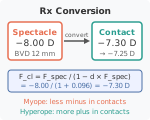
Quick Answer: You can't copy a spectacle prescription straight to a contact lens order. For prescriptions ≥ ±4.00 D, vertex distance conversion is required. Myopes end up with less minus in their contacts; hyperopes end up with more plus.
A patient hands you their glasses prescription and asks for contacts. You write the same numbers on the fitting form. Seems logical, but for anyone with meaningful refractive error, it's a mistake that leaves them blurry at distance or near.
Why You Can't Just Copy the Spectacle Rx
Spectacle lenses sit roughly 12 mm in front of the cornea. Contact lenses sit on the cornea. That 12 mm gap means the light reaching the retina travels a different optical path, and the lens power required to focus it correctly is different.
For low prescriptions like −1.50 D, the difference after conversion is only about 0.03 D. No available contact lens power differs by that amount, so the spectacle power works fine. But at −8.00 D the difference is around 0.70 D, which is three 0.25 D steps. That's a clinically meaningful error.
The rule of thumb: perform a conversion for any prescription ≥ ±4.00 D.
The Vertex Distance Formula
The conversion uses one formula:
F_cl = F_spec / (1 − d × F_spec)
- F_spec = spectacle lens power in dioptres
- F_cl = required contact lens power in dioptres
- d = vertex distance in metres (typically 0.012 for 12 mm)
That's it. No lookup tables needed, though you can always run the calculation instantly with our converter if you'd rather not do the arithmetic by hand.
Step-by-Step: Myope Example
Spectacle Rx: −8.00 DS, BVD 12 mm
Step 1: Set d = 0.012 m
Step 2: Apply the formula:
F_cl = −8.00 / (1 − 0.012 × −8.00)
F_cl = −8.00 / (1 + 0.096)
F_cl = −8.00 / 1.096
F_cl = −7.30 D
Step 3: Round to the nearest available power. Standard soft lenses come in 0.25 D steps, so −7.30 D rounds to −7.25 D.
The patient needs nearly three-quarters of a dioptre less minus in their contacts than in their glasses. Prescribing −8.00 D would leave them over-minused: distance vision blurred and asthenopia possible.
Step-by-Step: Hyperope Example
Spectacle Rx: +6.00 DS, BVD 12 mm
F_cl = +6.00 / (1 − 0.012 × +6.00)
F_cl = +6.00 / (1 − 0.072)
F_cl = +6.00 / 0.928
F_cl = +6.47 D
Rounded to the nearest 0.25 D: +6.50 D.
Hyperopes need more plus in contacts than in their spectacles. Moving the correcting lens closer to the eye means it needs to be stronger to produce the same effect on the vergence of light entering the eye.
Handling Astigmatism: Sphere and Cylinder Both Need Conversion
This is where many practitioners trip up. With a toric prescription, you can't just convert the sphere and leave the cylinder alone. You need to convert each principal meridian separately.
Example with Cylinder
Spectacle Rx: −6.00 / −1.50 × 180, BVD 12 mm
The two principal meridians are:
- Horizontal (180°): −6.00 D
- Vertical (90°): −6.00 + (−1.50) = −7.50 D
Convert each:
Horizontal: −6.00 / (1 − 0.012 × −6.00) = −6.00 / 1.072 = −5.60 D
Vertical:   −7.50 / (1 − 0.012 × −7.50) = −7.50 / 1.090 = −6.88 D
Reconstruct the contact lens power:
- Sphere = more positive meridian = −5.60 D → rounds to −5.50 D
- Cylinder = difference = −6.88 − (−5.60) = −1.28 D → rounds to −1.25 D
- Axis = 180 (axis never changes)
Contact lens Rx: −5.50 / −1.25 × 180
The axis stays the same. Only the dioptric magnitudes change. See our article on what is vertex distance for more on why the axis is unaffected.
Rounding to Available Powers
Contact lenses aren't made in every possible power. Most soft lenses step in 0.25 D increments up to about ±6.00 D, then switch to 0.50 D steps for higher powers.
When your calculated power sits exactly midway between two available steps (e.g., −7.50 D calculated, choices are −7.25 D or −7.75 D), clinical preference is usually to go with the less minus option for myopes and verify with overrefraction. An over-minused contact wearer complains of blurred near vision; an under-minused one simply asks for a slightly stronger lens at the next visit.
When the Difference Is Negligible
For prescriptions below ±4.00 D the vertex conversion changes the power by less than 0.12 D at a standard 12 mm BVD. Since the smallest available lens step is 0.25 D, the converted value rounds back to the spectacle power in most cases.
The crossover point (where the difference first rounds to a meaningful 0.25 D step) lands around ±4.50 D for most prescriptions. You can verify your specific values with the contact lens vertex calculator.
After the Conversion: Always Overrefract
A calculated power is a starting point, not a final Rx. Overrefraction (checking vision with the trial lens in situ) catches any residual error from rounding, individual variation in vertex distance, or tear lens effects with RGP lenses.
For well-established patients switching from one brand to another, a quick over-refraction takes 2 minutes and removes the guesswork. For new wearers, it's non-negotiable. Read more about managing high prescriptions specifically, where small errors compound quickly.
Our about page explains more about the clinical philosophy behind this tool.