What Is Vertex Distance? An Optometry Explainer
Vertex distance is the gap between your spectacle lens and the cornea, and it changes the power needed for contact lenses. Here's why it matters.
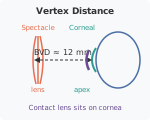
Quick Answer: Vertex distance is the gap, typically 12 mm, between the back surface of your spectacle lens and the front of your cornea. Because lens power varies with position, this gap means contact lenses (which sit on the cornea) need a different power than your glasses.
Most people assume their contact lens prescription is simply a copy of their glasses prescription. It isn't, and vertex distance is the reason why.
The Definition: Back Vertex Distance
Back vertex distance (BVD) is measured from the rear surface of the spectacle lens to the apex of the cornea. In clinical practice it usually falls between 10 mm and 14 mm, with 12 mm used as the standard assumption when no measurement is taken.
The number matters because the effective power of any lens changes depending on how far it sits from the point it's correcting. A −6.00 D lens placed 12 mm from the eye does not deliver the same optical correction as a −6.00 D lens placed directly on the cornea.
Back vs. Front Vertex Distance
You'll sometimes see "front vertex distance" (FVD) mentioned, which is measured from the front surface of the lens. For most routine conversions, back vertex distance is what counts. Thick high-minus or high-plus lenses have a non-trivial difference between the two, but for contact lens work BVD is the standard.
Why Position Changes Power
Imagine a diverging lens producing a virtual image 1 metre behind the lens (a −1.00 D lens by definition). As you move that lens closer to the eye, the image shifts slightly, and you need a little less divergence to send the light to the same retinal point.
For low prescriptions the shift is small enough to ignore. For high prescriptions it becomes clinically significant. That's the core reason vertex distance matters.
The ±4.00 D Rule of Thumb
The widely cited clinical rule is: if the spectacle prescription is ≥ ±4.00 D in any meridian, you should perform a vertex distance conversion.
Below that threshold the difference between spectacle power and contact lens power is usually 0.12 D or less, inside the rounding step for most available lens powers. Above it, the gap grows quickly and can easily exceed 0.25 D, which is the smallest step in which contact lenses are typically manufactured.
At −8.00 D the difference reaches about 0.70 D. Ignoring that would leave a patient noticeably under-corrected.
How Clinicians Measure It
Two methods are common in practice:
Distometer (vertex gauge). A small instrument with a retractable probe that rests on the corneal surface while the other end aligns with the spectacle lens back surface. It reads BVD directly in millimetres and is the most accurate method available.
Ruler or pupillary distance ruler. A quick estimate using a mm ruler held beside the frame. It's less precise (expect ±1–2 mm error), but adequate for most routine conversions when the prescription is only modestly above the ±4.00 D threshold.
Most trial frames used during refraction have a calibrated scale showing the BVD directly. When the final spectacle prescription is written with a specific BVD noted (e.g., "BVD 12 mm"), that's the value to use in the conversion.
The Vertex Distance Formula
The formula for converting spectacle power (F_spec) to contact lens power (F_cl) at a given vertex distance d (in metres) is:
F_cl = F_spec / (1 − d × F_spec)
Where d is the vertex distance in metres (so 12 mm = 0.012 m).
Worked Example: −6.00 D at 12 mm
F_cl = −6.00 / (1 − 0.012 × −6.00)
F_cl = −6.00 / (1 + 0.072)
F_cl = −6.00 / 1.072
F_cl = −5.60 D
Rounded to the nearest available 0.25 D step: −5.50 D.
That's a 0.50 D difference from the spectacle power, clinically significant, and easily checked with our vertex distance calculator before fitting.
Worked Example: +5.00 D at 12 mm
F_cl = +5.00 / (1 − 0.012 × +5.00)
F_cl = +5.00 / (1 − 0.060)
F_cl = +5.00 / 0.940
F_cl = +5.32 D
Rounded: +5.25 D. For hyperopes, contacts always require more plus than spectacles, the opposite direction to myopes.
When 12 mm Isn't the Right Assumption
Some patients have unusually high or low BVDs. Deep-set eyes, thick frames, and certain lens materials can push BVD to 14–16 mm. Shallow orbits or rimless frames can bring it down to 8–10 mm.
Using 12 mm as a default when the actual BVD is 15 mm introduces a small but real error on top of the conversion calculation. For anyone with a prescription above ±6.00 D, it's worth measuring rather than assuming.
You can plug any measured BVD directly into our conversion tool. It accepts values from 8 mm to 20 mm, so you're not locked into the 12 mm default.
A Note on Cylinder
Vertex distance conversion applies to every power meridian separately. If a prescription has both sphere and cylinder, you convert the sphere, convert the power along the cylinder meridian (sphere + cylinder), then reconstruct the contact lens sphere and cylinder from those two results. The axis remains unchanged.
This is one of the most commonly skipped steps in contact lens fitting. See our post on spectacle to contact lens conversion for the full worked example with cylinder.
Putting It Together
Vertex distance isn't an obscure formula tucked in the back of an optics textbook. It's a routine clinical step that becomes important whenever a patient's prescription crosses ±4.00 D, which describes a substantial portion of contact lens wearers.
The maths is straightforward, the measurement tools are simple, and the impact on patient vision is real. If you want to check a conversion quickly, calculate your conversion using the tool we've built on this site. Learn more about how this site approaches the optometry behind the numbers on our about page.