How to Measure Vertex Distance Accurately
Most practitioners default to 12mm, but measuring the actual vertex distance matters for high prescriptions. Here's how to do it right.
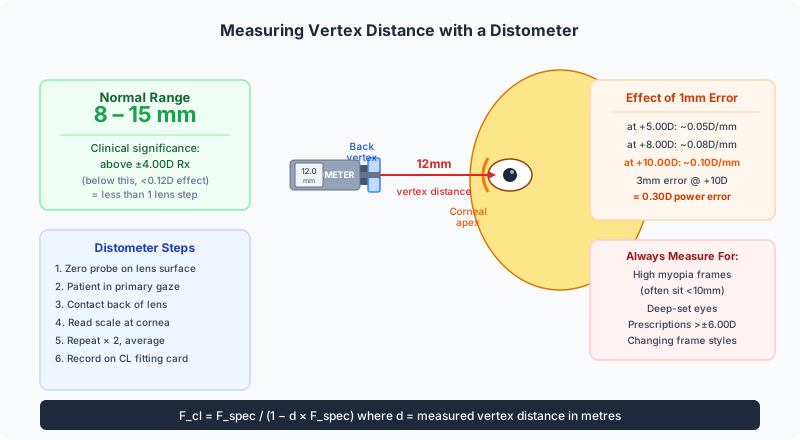
Quick Answer: Vertex distance is measured from the back surface of the spectacle lens to the anterior apex of the cornea, typically using a distometer. The standard assumed value is 12mm, but actual measurements commonly range from 8mm to 15mm and matter for any prescription above ±4.00D.
Most practitioners write "12mm" on every patient record without a second thought. For prescriptions under ±4.00D, that's fine. The vertex distance effect is small enough to be clinically irrelevant. But once you're fitting a patient with −9.00D of myopia or +7.00D of hyperopia, a 3mm error in vertex distance can shift the contact lens power by 0.25D or more. That's the difference between a well-fitted lens and a patient who keeps coming back saying something feels "off."
What You're Actually Measuring
Vertex distance is the linear distance, in millimetres, between the back vertex of the spectacle lens and the anterior apex of the cornea. It's not the distance to the pupil, the limbus, or the iris. It's specifically the front surface of the eye (the corneal apex).
The back vertex of a lens is the rear surface, the one facing the eye. For single-vision lenses this is straightforward. For progressives or bifocals, the vertex is still measured at the geometric back surface. The power distribution within the lens doesn't change the measurement technique.
Why the back vertex specifically? Because that's the optical reference point from which the specified back vertex power (BVP) of a spectacle lens is defined. The BVP is what your focimeter reads, and it's what the prescription describes.
Tools for Measuring Vertex Distance
Distometer
A distometer (sometimes called a vertex distance gauge) is the most accurate and widely used instrument. Common models include the Nikon PD ruler/distometer combo and the Essilor/Rodenstock-style monocular distometer.
The instrument has a small probe that contacts the back surface of the lens, and a scale calibrated to read the distance at the corneal plane. Most distometers have a range of 5mm to 35mm, with 1mm graduations. Some have a magnifying eyepiece to read the scale more clearly.
Millimetre Ruler Technique
When a distometer isn't available, a millimetre ruler can give an acceptable estimate. Place the ruler against the cheek below the eye and read the distance from the back of the lens to the corneal surface in primary gaze. It's less accurate than a distometer (expect ±2mm variability), but it's better than assuming 12mm for a high-prescription patient.
Slit-Lamp Estimation
With the patient wearing their spectacles and positioned at the slit lamp, you can estimate vertex distance by comparing the apparent gap between lens and cornea against the known diameter of the slit beam or reticule scale. This is a rough method and shouldn't be used as primary measurement for high prescriptions.
Step-by-Step Distometer Technique
Getting consistent, accurate readings with a distometer is mostly about patient positioning and zeroing the instrument correctly.
Step 1: Zero the distometer. Place the probe tip against a flat surface (a piece of glass or the lens surface itself before inserting into frames) and adjust the scale to read zero. Some distometers have a fixed zero; others need resetting at each use. Check the instrument manual.
Step 2: Position the patient. The patient should be seated upright, looking straight ahead in normal primary gaze, not tilted up or down. Head position matters because it affects the pantoscopic tilt of the frame and, therefore, the effective vertex distance at the optical axis.
Step 3: Contact the back lens surface. Gently place the distometer probe against the back surface of the spectacle lens at the point corresponding to the optical centre (for single-vision lenses, this is the geometric centre; for progressives, it's the fitting cross or distance reference point).
Step 4: Read the scale at the cornea. The distometer extends a secondary arm or uses a calibrated depth scale to read the distance at the corneal plane. With the probe seated against the lens, read the scale while the patient maintains forward gaze.
Step 5: Record and repeat. Take two readings and average them. The two values should agree within 1mm. If they don't, check that the patient hasn't shifted gaze between measurements. Record the result on the patient's dispensing record as well as the contact lens fitting record.
After measuring, you can plug the actual vertex distance directly into the contact lens vertex power calculator to get a precise converted prescription.
Normal Range and When Variation Matters
The clinically typical range is 8mm to 15mm. Values outside this range can indicate unusual frame fit (very close to the face, or with a low-sitting bridge) or anatomical variation (deep-set eyes, prominent brow).
The key threshold for clinical significance is ±4.00D. Below this power, the maximum vertex distance effect, even across the full 8–15mm range, is less than 0.12D. That's smaller than the nearest lens step and smaller than the repeatability of most clinical refractions.
Above ±4.00D, a 1mm change in vertex distance produces a progressively larger change in the effective power at the cornea. At +10.00D, each millimetre of vertex distance changes the corneal plane power by approximately 0.10D. A 3mm measurement error means a 0.30D power error, and that's before rounding to the nearest available lens step.
Recording Vertex Distance on Clinical Records
Vertex distance should appear in two places: the spectacle dispensing record and the contact lens fitting record.
On the dispensing record, note the measured vertex distance alongside the prescription. This is especially important for repeat patients. If a patient changes frames, the new vertex distance may differ, and the effective power at the eye changes even though the prescription hasn't.
On the contact lens record, note both the measured spectacle vertex distance and the converted contact lens power. This allows you (or a colleague) to verify the conversion calculation at a future visit without re-measuring.
Special Cases Worth Extra Attention
High Myopia Frames
Patients with high myopia often choose frames with smaller eye sizes specifically to minimise lens thickness and edge bulk. These frames typically sit closer to the face, so the vertex distance is often 10mm or less rather than the standard 12mm. Assuming 12mm and then performing a vertex conversion with the wrong reference distance compounds the error. Always measure these patients.
Progressive Lenses
Progressives have a fitting cross that's typically 4mm above the near reference point and a specific vertex distance is assumed during lens design. If a patient changes to contact lenses, measure the vertex distance at the fitting cross position, not the near vision zone.
Deep-Set Eyes
Patients with pronounced brow ridges or deep orbital anatomy may have the spectacle lens closer to the eye than average, sometimes as low as 7mm or 8mm. These patients may find that the standard 12mm conversion over-corrects their contact lens power.
Post-Surgical Patients
Patients with a history of corneal refractive surgery (LASIK, PRK, orthokeratology) often have irregular corneal topography. The "corneal apex" is a less well-defined reference point, and vertex distance measurements should be interpreted with this in mind. The conversion calculation itself remains valid; it's the measurement of the reference point that requires care.
For high prescriptions in any category, the vertex distance calculator should be used with the measured value rather than the assumed 12mm. It takes 10 seconds and removes a common source of fitting error. See our overview of what vertex distance means optically for more background on why the measurement matters so much.
The 12mm default exists because it's a reasonable population average, not because individual variation doesn't exist. Measuring takes less time than a re-fitting visit.
Recording and Using the Measurement
Once you have the actual vertex distance, the conversion process is identical to the standard approach. You just substitute the measured value for 12mm. A patient with an actual vertex distance of 10mm and a spectacle Rx of −8.00D needs a different contact lens power than someone with the same Rx at 14mm:
- At 10mm: F_cl = −8.00 / (1 + 0.080) = −7.41D → rounds to −7.50D
- At 14mm: F_cl = −8.00 / (1 + 0.112) = −7.19D → rounds to −7.25D
That's a 0.25D difference just from the vertex distance, with no change in the underlying prescription. For a repeat fitting where the patient has changed frames, this matters.
Enter the measured vertex distance into the contact lens vertex power calculator alongside the spectacle power to get the precise converted value. Our about page covers the clinical background behind why this tool was built.