Contacts vs Glasses: Why the Prescription Numbers Differ
If your glasses say −7.00D but your contact lenses say −6.50D, that's not a mistake. Vertex distance explains the difference, and it's intentional.
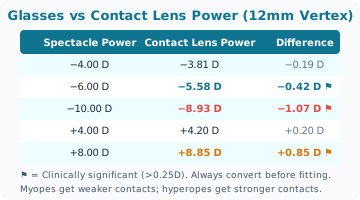
Quick Answer: Contact lenses and glasses carry different power numbers for the same person because contact lenses sit directly on the eye while glasses sit ~12mm in front of it. For prescriptions stronger than ±4.00D, that gap changes the optics enough to require a different power.
You've noticed it on your prescriptions. Your glasses say −7.00D, but your optician writes −6.50D on the contact lens order form. You haven't changed since your last eye test. Nothing went wrong. This is intentional, and understanding why helps you trust the process.
The Gap Is the Point
Spectacle lenses sit roughly 12 millimetres in front of the surface of your eye. Contact lenses sit directly on the eye. That 12mm gap might seem trivial, but optics doesn't think in terms of "roughly". The position of a lens relative to the eye matters precisely.
Think of it this way. A magnifying glass held far from a surface focuses light at a certain point. Move the same glass closer to the surface, and the focal point shifts. To focus at the same spot again, you'd need a glass with a slightly different power.
Your eye is the surface. The lens, whether glasses or contacts, is the magnifying glass. Moving it from 12mm away to directly on the eye changes the optical effect, so the power must change too.
Why Myopes Get Less Minus in Contacts
Short-sighted (myopic) eyes need minus lenses to push the focal point back from in front of the retina to the retina itself. A minus lens diverges light.
When a minus lens moves closer to the eye, its diverging effect on the light reaching the eye actually decreases slightly. The light is diverged over a shorter distance before hitting the cornea. So you need a less powerful minus lens when it's sitting on the eye compared to 12mm in front of it.
That's why your −7.00D glasses translate to something like −6.50D in contacts. The contact lens does slightly less work per dioptre because it's in a more efficient position.
Why Hyperopes Get More Plus in Contacts
Long-sighted (hyperopic) eyes need plus lenses to converge light enough to reach the retina. When a plus lens moves closer to the eye, its converging effect weakens. The focused point moves farther away from the lens, and the eye has to work harder to catch it.
To achieve the same effect at the corneal surface, a stronger plus lens is needed. So a +5.00D spectacle prescription might require +5.31D in contact lenses.
The direction is opposite to myopia: hyperopes need more power in contacts, myopes need less.
The Numbers at a Glance
Here's what the difference looks like across common prescription strengths, assuming a standard 12mm vertex distance:
You can verify any specific prescription using the contact lens vertex distance calculator. Put in your spectacle power, set 12mm vertex distance, and it shows you the contact lens equivalent.
Below ±4.00D: The Difference Doesn't Matter
Look at the −3.00D row above. The contact lens power works out to −2.90D, a difference of 0.10D. Contact lenses aren't made in 0.10D increments; the smallest available step is 0.25D. So the converted value rounds straight back to −3.00D anyway.
This is why practitioners don't bother converting low prescriptions. For anything below ±4.00D, the vertex distance effect is smaller than the precision of available contact lens powers. The spectacle number is used directly, and no accuracy is lost.
Above ±4.00D, the difference starts to span one or more 0.25D steps, and that's where copying the spectacle prescription becomes a clinical error.
What Actually Happens If You Wear the Wrong Power
For short-sighted wearers
If a myope wears contacts at their spectacle power, say, −7.00D instead of −6.50D, they're wearing 0.50D more minus than they need. This is called being "over-minused."
Short-term effects: vision may seem sharp initially, but distance objects can look slightly smaller than normal (minification from the stronger minus lens). At near, extra effort is required to focus, which can cause headaches or eye strain over a long day.
This isn't dangerous, but it's not comfortable, and it'll become apparent at their next vision check.
For long-sighted wearers
A hyperope wearing contacts at their spectacle power, say, +5.00D instead of +5.31D, is "under-plussed." They're not getting enough plus power to relax their eye's focusing system.
Younger hyperopes with good accommodation might compensate without realising it, but they'll tire more easily. Older hyperopes with reduced accommodation will notice blurred distance vision or struggle to read. For presbyopic hyperopes, this double under-correction can make near vision very difficult.
The Formula, Without the Maths Degree
If you're curious about the exact calculation, it's straightforward. The formula is:
Contact lens power = Spectacle power ÷ (1 − vertex distance × spectacle power)
Using the −7.00D example with 12mm (0.012m) vertex distance:
CL power = −7.00 ÷ (1 − 0.012 × −7.00)
         = −7.00 ÷ (1 + 0.084)
         = −7.00 ÷ 1.084
         = −6.46D → rounded to −6.50D
The denominator is slightly above 1 for minus powers (making the result less minus) and slightly below 1 for plus powers (making the result more plus). That's the whole mechanism.
You don't need to do this by hand. The vertex distance power calculator takes care of it. Enter your spectacle power, confirm the vertex distance, and the contact lens equivalent appears.
What If Your Frames Sit Unusually Close or Far?
The standard 12mm vertex distance is an average. Some frames sit closer to the eye (high myopia patients often choose small, close-fitting frames to minimise lens edge thickness), and some sit further out. Unusually large frames or thick fronts can push the vertex to 14mm or 15mm.
For prescriptions around ±4.00D–6.00D, this variation only shifts the result by 0.10D–0.20D, usually within the rounding to available lens powers. For stronger prescriptions (above ±8.00D), a 2mm change in vertex distance can move the contact lens power by more than 0.25D, which is clinically meaningful.
If you've been re-fitted for glasses with frames that sit noticeably closer or further from your eye than your previous pair, and your contact lenses then feel "off," this vertex distance change is a plausible cause, even if your underlying prescription hasn't changed.
Your optician can measure the actual vertex distance using an instrument called a distometer and redo the conversion with the correct value. See the post on measuring vertex distance accurately for details on the technique.
Should Patients Know About This?
Yes, and explaining it takes about 30 seconds. When patients understand why their prescription numbers differ between glasses and contacts, two things happen:
Compliance improves. A patient who thinks their optician made a mistake on the contact lens order is more likely to delay reordering or ask for "the right number." A patient who understands the conversion trusts the numbers and reorders without hesitation.
Symptoms get reported correctly. If a patient knows their contacts should have less minus than their glasses, and they're experiencing distance blur in their contacts, they'll report it accurately rather than assuming the contacts are just different from glasses.
Ordering online becomes safer. Patients who order contact lenses online and need to re-enter their prescription understand why the numbers on their glasses box don't match the numbers on their contact lens box, and they don't accidentally order the wrong power.
The vertex distance calculator can even be shown to patients directly, inputting their own spectacle power and seeing the conversion happen in real time is more persuasive than a verbal explanation.
For practitioners who want the clinical depth behind these numbers, our post on spectacle to contact lens conversion covers the formula and worked examples. Our about page explains why we built this tool and who it's designed to help.
The prescription difference between your glasses and contacts isn't an inconsistency. It's evidence that someone did the conversion correctly.