Hyperopia and Contact Lenses: Why the Power Goes Up
Hyperopic contact lenses need more positive power than the spectacle prescription, often by 0.50D or more. Here's the reason and the numbers.
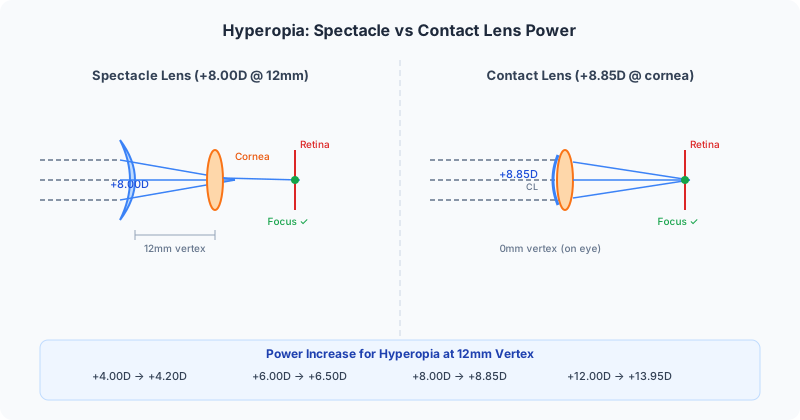
Quick Answer: Hyperopic (long-sighted) patients need more positive power in contact lenses than in their spectacles. A +8.00D spec prescription typically becomes around +8.85D at the corneal plane, an increase driven entirely by vertex distance.
Most people assume that glasses and contact lenses carry the same numbers. For low prescriptions, that's close enough to be true. But once you're dealing with positive powers above +4.00D, the vertex distance effect becomes significant enough to change the prescription by a meaningful amount, and ignoring it leads to under-corrected patients who can't read a menu without squinting.
How Converging Lenses Work at Distance
A positive (plus) lens converges light. When you move that lens closer to the eye, the focal point it creates also moves closer. That's a problem. The eye now needs to reach for the image, so it has to work harder to bring the converged beam onto the retina.
To compensate, you need a stronger lens to push that focal point back to the correct distance. This is why hyperopic contact lens powers are always higher than their spectacle equivalents. The lens is sitting right on the eye rather than 12mm in front of it, so it needs to do more work.
This isn't an approximation or a rule of thumb. It's a direct consequence of vergence optics. The formula uses the spectacle refraction (F_s) and vertex distance (d, in metres):
F_c = F_s / (1 − d × F_s)
At a 12mm vertex, a +8.00D spectacle lens becomes:
F_c = 8.00 / (1 − 0.012 × 8.00) = 8.00 / 0.904 ≈ +8.85D
Real Numbers at 12mm Vertex Distance
It helps to see this across a range of prescriptions so the pattern is clear:
At low powers like +2.00D, the difference of 0.05D is smaller than the nearest available contact lens step (0.25D), so it's clinically irrelevant. At +12.00D, you're looking at nearly +2.00D of difference, which absolutely cannot be ignored.
You can run any of these conversions instantly using the vertex distance power calculator.
What Happens If You Use Spectacle Power for the Contact Lens
If a patient with a +8.00D spectacle prescription is fitted with +8.00D contact lenses, they'll be under-plussed by nearly 0.85D. This has a few consequences:
- Distance vision is slightly blurred. Objects aren't brought into focus sharply.
- Near vision suffers even more. Because the lens isn't providing enough plus, the patient exhausts their accommodation faster and may report headaches or fatigue.
- The patient may appear to pass the distance visual acuity test "well enough" (perhaps 6/9), which masks the under-correction, especially in younger hyperopes who can accommodate to compensate.
This kind of silent under-correction is frustrating for patients and avoidable with a proper vertex conversion.
The Presbyopia and Hyperopia Double Challenge
Presbyopic hyperopes present a particular fitting challenge. They need significant plus power for distance, and they're losing amplitude of accommodation, which means they need an addition for near.
Distance Power First
Start by correctly converting the spectacle distance power. If the patient is +5.00D in spectacles, the contact lens distance power should be approximately +5.31D (at 12mm vertex). Fitting at +5.00D leaves them under-corrected at distance before the near problem is even addressed.
The Near Addition
Presbyopic adds are typically recorded in spectacle terms, but since the add lenses sit at the same vertex distance as the distance lens, the add power itself is less affected by vertex distance (it operates closer to the eye's near point). In practice, the spectacle add is often used as a starting point for the multifocal contact lens addition, then refined with overrefraction.
Patients with high hyperopia and presbyopia often find multifocal contact lenses difficult because the distance power is already high, leaving little room in lens geometry for the add zone. Managing expectations early is important. See our post on presbyopia and multifocal contact lenses for the fitting approach.
Vertex Distance Isn't Always 12mm
The 12mm figure is the clinical standard, but it's not universal. Patients with small faces, low nose bridges, or fitted with rimless frames often have shorter vertex distances, sometimes as low as 8mm. Deep-set eyes or thick frame fronts may push to 15mm or more.
For prescriptions above +6.00D, it's worth measuring the actual vertex distance rather than defaulting to 12mm. A 3mm difference in vertex distance at +10.00D changes the contact lens power by around 0.30D, enough to affect the fit outcome.
Measuring Vertex Distance
A distometer gives the most accurate reading. With the patient in normal primary gaze, the instrument contacts the back surface of the spectacle lens and the scale is read at the anterior corneal apex. For a more detailed walkthrough of the technique, see how to measure vertex distance accurately.
Practical Clinical Tips for Hyperopic Fittings
A few things that help when fitting contact lenses on hyperopic patients:
Always convert before ordering. Even for a +4.00D patient, the 0.20D difference might be enough to push the prescription across a 0.25D step from +4.00D to +4.25D. That's a meaningful change.
Check near vision in the trial lens. Hyperopes rely more heavily on accommodation. Even with the correct distance power, a patient in their early 40s may notice near vision is harder than expected. This can indicate early presbyopia that the spectacle correction was masking via accommodation.
Use the calculator. Mental arithmetic for vertex conversion is error-prone, especially across a full clinic day. The contact lens vertex power calculator gives you the converted power in seconds, enter the spectacle power, set the vertex distance, and read off the contact lens equivalent.
Don't round the wrong way. When the converted power falls between contact lens steps, round toward the more positive option for hyperopes. Under-correcting a hyperope compounds their accommodation workload.
When the Difference Isn't Clinically Significant
For prescriptions of +3.00D or below, the vertex distance effect is less than 0.12D at a 12mm vertex. This is within the precision of most refraction techniques and well below the 0.25D step of available contact lenses. In these cases, using the spectacle power directly for the contact lens is clinically acceptable.
Above +4.00D, always convert. Above +6.00D, consider measuring the actual vertex distance rather than assuming 12mm. Above +10.00D, the conversion makes a difference of more than 1.00D, treating it as optional isn't appropriate.
The underlying physics is simple: a plus lens closer to the eye must be stronger. The numbers confirm it, and your patients' outcomes will reflect whether you account for it or not.
Explaining the Difference to Patients
Many hyperopic patients are confused when they see different numbers on their glasses and contact lens prescriptions. The most useful explanation is brief and concrete: "The contact lens sits right on your eye instead of 12mm in front of it, so it needs to be a bit stronger to do the same job."
Patients with strong plus prescriptions (+6.00D and above) often notice that their contacts feel different from their glasses in terms of visual size. Plus lenses magnify slightly, and this effect diminishes as the lens moves closer to the eye. Contacts at the corneal plane produce less magnification than spectacles at 12mm, which can actually be more comfortable for high hyperopes who've always found their glasses made the world look larger than it really is.
If a patient reports that their contact lenses "aren't as strong" as their glasses despite both being correctly prescribed, this perceptual difference in magnification is often the cause, not a power error. The about page has more context on how this tool approaches common fitting questions like these.