Contact Lens Power for Myopia: Why It's Weaker Than Your Glasses
Myopic contact lenses always carry less negative power than the spectacle prescription. Here's the optics behind it, with real numbers.
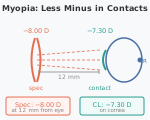
Quick Answer: Myopic contact lenses need less negative power than spectacle lenses because moving the lens closer to the cornea reduces how much divergence is required. A −8.00D spectacle lens converts to around −7.30D at standard 12mm vertex distance.
Optometrists deal with this every day, yet it's still one of the most frequently misunderstood aspects of contact lens prescribing. A patient's glasses say −7.50D. Their contact lenses say −7.00D. The patient asks whether there's been a mistake. There hasn't. The two numbers are supposed to be different, and the reason is straightforward once you understand what vertex distance does to a diverging lens.
How Myopic Lenses Work
Myopia means the eye focuses parallel rays of light in front of the retina. Correcting this requires a diverging lens, one with negative power, that spreads light out before it enters the eye, moving the focal point back to the retina.
The key word is diverging. A diverging lens pushes light rays apart. How much it needs to do this depends on how far it sits from the eye. When the lens is further away, it has to do more work to ensure the light arrives at the correct vergence by the time it reaches the cornea. Move it closer, as you do when switching from spectacles to contacts, and the lens can be weaker while producing the same effect at the corneal plane.
This follows directly from vergence transfer, the principle that governs how optical power works at different positions along the visual axis.
The Numbers: What Happens at Each Power Level
Using the vertex distance formula at 12mm, here's how the conversion looks across a range of myopic prescriptions:
Below −4.00D, the difference is under 0.25D and may not require adjustment. Above −6.00D, the gap grows substantially. At −10.00D, you need over 1.00D less minus in the contact lens, a significant error if ignored.
To calculate the precise conversion for any prescription, use our vertex distance calculator.
When the Difference Actually Matters
The clinical rule of thumb is ±4.00D. Below that threshold, the power difference is typically under 0.25D, below what most patients notice and below the standard contact lens prescription step.
Above −4.00D, you should calculate rather than guess. At −6.00D, using the spectacle power directly gives a 0.42D over-minused result. For a patient with a sensitive refraction, that will reduce visual performance. You might still end up prescribing −6.00D after overrefraction if that's the closest available lens power, but you should know the theoretical target is −5.58D, not −6.00D.
Check whether your patient's prescription crosses the significance threshold with our contact lens converter. It flags whether the power difference is clinically meaningful.
Why High Myopes Often See Better in Contacts
High myopes frequently report sharper distance vision in contact lenses, even before any overrefraction adjustment. Part of this is real and expected.
Spectacle lenses for high myopia minify the retinal image: the stronger the minus lens, the smaller the perceived image. Contact lenses at the corneal plane produce less minification because they sit closer to the eye's nodal point. The vertex distance correction partially explains the subjective improvement: the patient isn't over-minused, so the correction fits the eye's optics more precisely.
There's also a visual field advantage. High minus spectacle lenses restrict peripheral vision because the peripheral lens is optically compromised. Contact lenses give a full, unobstructed field, something high myopes often notice immediately.
Selecting Trial Lenses in Practice
Once you've calculated the converted power, round to the nearest available increment. Most soft lenses come in 0.25D steps up to about −6.00D, then 0.50D steps above that.
For a conversion of −5.58D, trial −5.50D and −5.75D and confirm through overrefraction. For −7.30D, trial −7.25D and −7.50D, or −7.00D and −7.50D if the lens only comes in 0.50D steps above −6.00D.
Don't skip overrefraction. The theoretical conversion is a starting point. Back optic zone radius, lens flexure, and individual corneal curvature can shift the effective power by another 0.25D in either direction.
Astigmatism: Converting Both Components
For myopic patients with astigmatism, both sphere and cylinder need vertex distance conversion, applied independently. The axis of astigmatism doesn't change.
Example: −6.00 / −1.50 × 180 at 12mm vertex:
- Sphere: −6.00D → −5.58D
- Cylinder: −1.50D → −1.45D
- Axis: unchanged at 180°
The toric order would typically be −5.50 (or −5.75) / −1.50 × 180, rounded to available powers. For more on this, see our guide on astigmatism contact lens fitting.
Common Mistakes
Using spectacle power directly for high myopes. A −10.00D patient fitted at −10.00D will be roughly 1.00D over-minused. That shows up in acuity and patient complaints.
Rounding in the wrong direction. If the converted power is −5.58D and available powers are −5.50D and −6.00D, start with −5.50D, don't default to the nearest round number.
Not recalculating when the spectacle Rx changes. If a patient's glasses are updated from −7.00D to −8.00D, the contact lens equivalent doesn't change by the same 1.00D increment. Recalculate from scratch each time.
For a complete walkthrough of the conversion process, see our guide to spectacle-to-contact lens conversion.
How to Apply This in Practice
The conversion step fits naturally into a contact lens fitting workflow. After completing the spectacle refraction, run the vertex calculation before selecting a trial lens, not after the patient has worn a poorly powered lens for two weeks.
For prescriptions between −4.00D and −6.00D, the typical saving is 0.25D to 0.50D of minus. It's quick to check and easy to justify: a 30-second calculation prevents a return visit.
For prescriptions above −8.00D, it's worth recording the actual vertex distance from the trial frame rather than assuming 12mm. A patient with deep-set eyes at a genuine 14mm vertex will need a different conversion than the 12mm standard gives.
The contact lens vertex calculator accepts any vertex distance from 8mm to 20mm. Enter the spectacle power and the measured BVD, and it returns the contact lens power with a note on whether the difference is clinically significant.
Learn more about the clinical methodology behind this tool on our about page.